TikTok Shop statistics for 2026 point one direction: up. eMarketer forecasts $23.41 billion in U.S. TikTok Shop retail e-commerce sales in 2026, which would top its forecast for Target's online sales. Below are the 12 numbers that matter most, ranked by how directly each one should shape your 2026 plan, from top-line market size down to the build-or-hire decision.
We ranked these by decision weight: the market-size and revenue figures come first because they tell you whether to be on the platform at all. Operational benchmarks (live selling, creators, AOV) come next because they shape how you run. The limitation and the agency-versus-DIY call close it out because they decide how you execute.
Key takeaways
- eMarketer forecasts $23.41 billion in U.S. TikTok Shop sales in 2026, ahead of its Target online forecast of $21.94 billion.
- U.S. TikTok Shop GMV hit an estimated $15.1 billion in 2025, up 68% year over year; global GMV reached an estimated $64.3 billion across 16 regions.
- Live selling is the fastest-growing format: sellers ran more than 760,000 livestream sessions over the 2025 Black Friday weekend, with 84% year-over-year sales growth.
- TikTok Shop's platform commission is 6% per sale with no setup fee, but total selling costs can reach 35%-55% of revenue once ads, shipping, and affiliate payouts are counted.
- TikTok Shop is a poor fit for B2B, ultra-luxury, and low-margin commodity sellers; it rewards products with creator appeal and healthy margins.
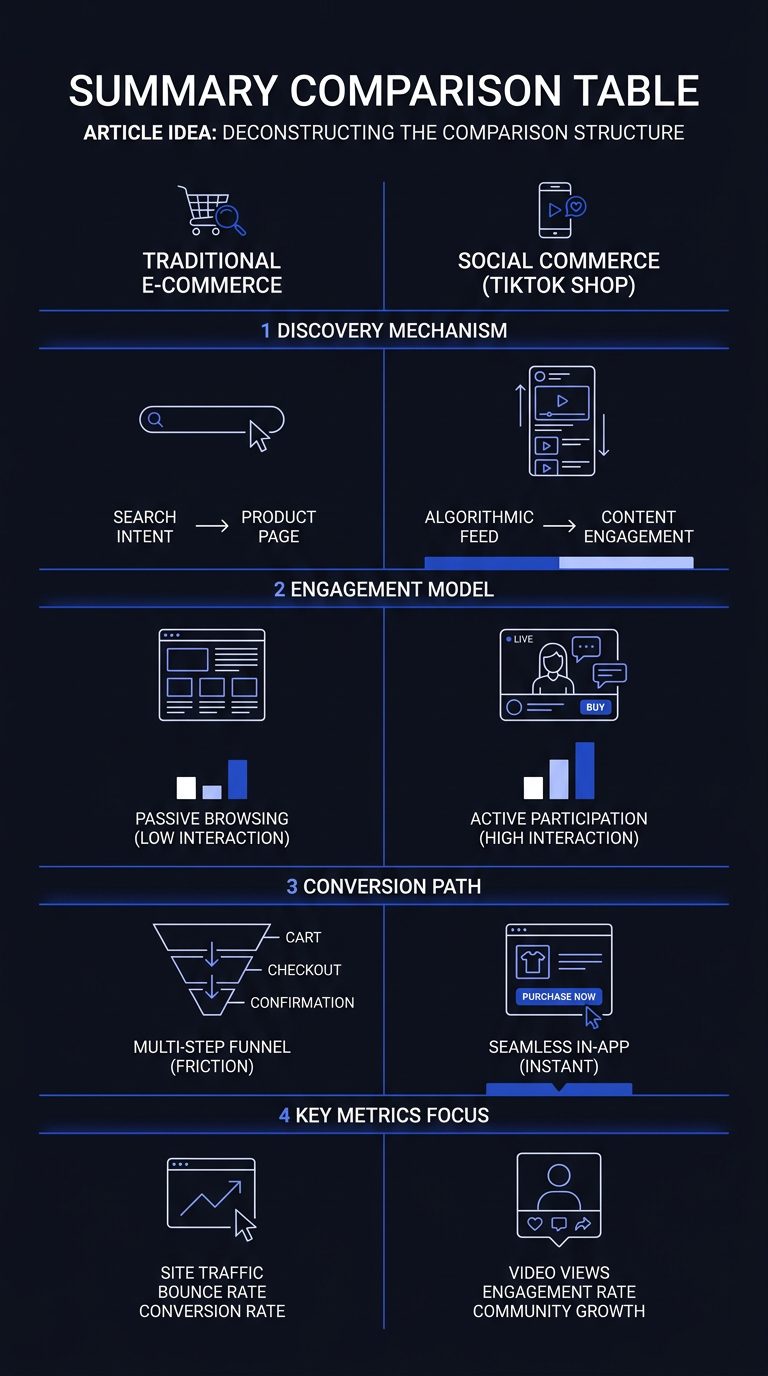
Table of contents
- TikTok Shop Growth: The 2026 Market Reality
- How Much Revenue Does TikTok Shop Generate?
- Live Selling: The Dominant Transaction Model on TikTok
- How Many Creators Are Selling on TikTok Shop?
- What's the Time-to-Live Selling for New Brands?
- Live Selling Volume: How Many Streams Happen Daily?
- Which Product Categories Perform Best in TikTok Shop?
- What's the Average Order Value and Conversion Rate?
- TikTok Shop Affiliate Marketing: Performance by Creator Tier
- Geographic Expansion: Where TikTok Shop Is Growing Fastest
- When TikTok Shop Doesn't Fit Your Strategy
- Should You Hire an Agency or Go DIY?
Summary comparison table
| # | Statistic area | 2026 figure or benchmark | Source | What it tells you |
|---|---|---|---|---|
| 1 | Market growth | 35% of U.S. adults have used TikTok Shop (up from 23% in 2025) | CivicScience / eMarketer, 2026 | Adoption is still climbing |
| 2 | Revenue | $23.41B U.S. forecast | eMarketer, 2026 | Top-line opportunity |
| 3 | Live selling | 760,000+ holiday livestreams, +84% YoY | Modern Retail, 2025 | Live is the growth format |
| 4 | Live selling | 3,500+ live hours a month (Platinum Commerce) | Platinum Commerce, 2026 | Consistency drives live sales |
| 5 | Onboarding | ~10 weeks to live (managed) | Platinum Commerce, 2026 | Realistic ramp time |
| 6 | Stream volume | 7,000+ videos/month (Platinum Commerce) | Platinum Commerce, 2026 | Volume beats polish |
| 7 | Categories | Electronics, home, gaming, lifestyle lead | Platinum Commerce portfolio, 2026 | Where demand sits |
| 8 | AOV | $118 per customer over 12 months | NielsenIQ / eMarketer, 2026 | Repeat-purchase channel |
| 9 | Affiliates | 10%-20% typical creator commission | OneCart / ClickAnalytic, 2026 | Affiliate payout range |
| 10 | Geography | 16 regions, $64.3B global GMV | ClickAnalytic, 2025 | Where to expand |
| 11 | Poor fit | B2B, ultra-luxury, low-margin | Platinum Commerce view, 2026 | Where it stops working |
| 12 | Build vs hire | 35%-55% of revenue in total costs | OneCart, 2026 | Decides execution path |
TikTok Shop Growth: The 2026 Market Reality
Best read as the headline number: TikTok Shop is now a mainstream U.S. shopping channel, and the brands that treat it that way in 2026 win. Adoption data makes the case. A March 2026 CivicScience survey reported by eMarketer found that 35% of U.S. adults had used TikTok Shop, up from 23% in 2025. NielsenIQ data cited by eMarketer shows 9% of U.S. households bought through TikTok Shop during the 12 months ending February 2026, with sales up 84% over that period.
Two forces drive this. First, more buyers are arriving. Second, live selling is becoming the default way products move, replacing the old "post and hope" feed model. We see this daily in our Beverly Hills studio. The algorithm rewards volume and native video, not polished ads.
The limitation: adoption numbers are survey and panel estimates, not audited platform figures, so treat them as direction, not gospel.
How Much Revenue Does TikTok Shop Generate?
Best for sizing the opportunity: the revenue is now large enough that ignoring it costs you. eMarketer forecasts $23.41 billion in U.S. TikTok Shop retail e-commerce sales in 2026, a figure that would exceed its forecast for Target's online sales of $21.94 billion the same year. U.S. GMV was already an estimated $15.1 billion in 2025, up 68% year over year.
A few benchmarks worth acting on:
- Established brands are scaling fastest. TikTok reported that sales from brands with at least $30 million in annual revenue rose 97% year over year in 2025.
- Operators move real volume. We carry 100+ brands across consumer electronics, home, gaming, and lifestyle.
The limitation: GMV estimates vary by methodology and are not audited platform revenue. Our own results reflect the brands we carry, not a platform-wide benchmark you can expect to match.
Live Selling: The Dominant Transaction Model on TikTok
Best for conversion in 2026: live selling now outpaces shoppable video and collection pages, and it is where we focus most of our hours. During the 2025 Black Friday-Cyber Monday period, sellers hosting livestreams recorded 84% year-over-year sales growth across more than 760,000 livestream sessions, according to Modern Retail. That holiday weekend alone, TikTok Shop sales topped $500 million.
Live works because it compresses discovery, demonstration, and checkout into one session. A host answers questions in real time, drops limited offers, and closes while attention is high.
According to Platinum Commerce's studio operations in 2026, we stream TikTok LIVE shopping from 12 live rooms, running daily. That is how you scale a channel that rewards hours on air, not one-off broadcasts. You can see how we run it on our live selling page.
The limitation: live selling is labor-intensive. It needs trained hosts, a production setup, and consistent airtime, which is hard to sustain with a single part-time streamer.
How Many Creators Are Selling on TikTok Shop?
Best for understanding scale: TikTok Shop runs on creators, and the number you work with directly shapes reach. Creator affiliates tag products, review them, and drive the discovery feed that feeds the algorithm. A brand selling solo on TikTok Shop is leaving the main engine idle.
We manage a broad pool of affiliate creators through an in-house affiliate sample center. That breadth matters because creator performance is uneven. Most campaigns rely on a long tail of mid-size creators plus a handful of breakout videos.
Practical reality we see: the mix skews heavily part-time. A small share of creators sell full-time; the majority post alongside other income. You win by casting wide and sampling often, not by betting on one name. Our affiliate and creator management approach is built around that math.
The limitation: creator counts are a capacity figure, not a guarantee. Sending 1,000 samples does not promise 1,000 selling videos.
What's the Time-to-Live Selling for New Brands?
Best for planning: budget roughly 10 weeks from onboarding to a scaled live presence if you run managed, longer if you go fully DIY. According to Platinum Commerce's onboarding timelines in 2026, brands we work with typically go from onboarding to live selling in about 10 weeks. That covers shop setup, compliance and tax verification, catalog and content production, creator sampling, and host training before the first consistent stream.
The common bottlenecks that stretch the timeline:
- Compliance and verification. Tax info and product-compliance checks gate your selling features.
- Content pipeline. You need a steady supply of native video before affiliates and ads have anything to push.
- Follower and eligibility thresholds. Live access in-app depends on meeting account requirements.
We detail the full path on our how it works page. For context on why the Amazon playbook does not transfer, see our breakdown of why your Amazon strategy won't work on TikTok Shop.
The limitation: 10 weeks is a managed-partner timeline with an in-house team. A brand building from scratch, hiring hosts and learning the platform, should expect longer.
Live Selling Volume: How Many Streams Happen Daily?
Best for grasping operational scale: TikTok Shop runs on relentless volume, and matching it is the hard part. The holiday figure frames the scale: more than 760,000 livestream sessions ran over the 2025 Black Friday-Cyber Monday weekend alone, per Modern Retail. Day to day, successful sellers stream for hours, often during evening peak-shopping windows, because the algorithm favors consistency and airtime.
Volume applies to short-form video too. According to Platinum Commerce's content production records in 2026, we produce more than 7,000 creator videos a month in-house. That cadence exists because most videos underperform and a few break out. You cannot predict the winners, so you produce enough to find them.
The limitation: this volume is expensive to generate. Most in-house teams cannot produce thousands of videos a month, which is why many brands plateau on content rather than demand.
Which Product Categories Perform Best in TikTok Shop?
Best for category fit: visual, demonstrable, giftable products lead, which is why electronics, home, gaming, and lifestyle dominate strong seller portfolios. These categories show well on camera, benefit from live demonstration, and carry enough margin to fund creators and ads.
According to Platinum Commerce's brand roster in 2026, we carry more than 100 brands concentrated in consumer electronics, home, gaming, and lifestyle, including Vitamix, Lenovo, Glorious and AOSU. Those are the segments where live demos and creator reviews convert hardest.
What makes a category perform:
- Demonstrability. A host can show the product working on air.
- Impulse and gift appeal. Price points that clear quickly in a live session.
- Repeat potential. Consumables and accessories drive the three-to-four-purchase pattern buyers show.
The limitation: our roster reflects our own focus, not a platform-wide category ranking. The NielsenIQ spend data does not confirm that per-customer averages hold equally across every category.
What's the Average Order Value and Conversion Rate?
Best for forecasting: treat TikTok Shop as a repeat-purchase channel, not a one-big-order channel. NielsenIQ data reported by eMarketer shows the average U.S. TikTok Shop customer spent $118 during the 12 months ending February 2026 and made three to four purchases. That works out to a modest per-order value with meaningful repeat behavior.
Conversion patterns we see in the studio:
- Live converts higher than feed. A live viewer is already watching a demo with checkout one tap away, so conversion on live outruns passive shoppable posts.
- Experience compounds. Seasoned sellers with trained hosts and tight offers convert better than first-timers reading from a script.
| Metric | Benchmark | Source |
|---|---|---|
| Spend per customer (12 mo. to Feb 2026) | $118 | NielsenIQ / eMarketer, 2026 |
| Purchases per customer | 3 to 4 | NielsenIQ / eMarketer, 2026 |
| Established-brand sales growth | +97% YoY | TikTok / eMarketer, 2025 |
The limitation: published, audited conversion and cart-abandonment rates for TikTok Shop are scarce. Treat any single conversion figure you see online skeptically; benchmarks vary widely by category and seller maturity.
TikTok Shop Affiliate Marketing: Performance by Creator Tier
Best for driving GMV without fronting all the ad spend: affiliate marketing for TikTok Shop, paid on results. Sellers set creator commission rates. Published guidance notes available rates can technically range from 1% to 80%, but typical working ranges are far narrower: commonly 10%-20% of sale value for scaling campaigns, with some cost analyses placing affiliate-driven commissions at 8%-15%, according to OneCart and ClickAnalytic.
How tiers tend to play out:
- Micro creators (5K-50K): cheapest to sample, highest volume, uneven hit rate. Won through breadth.
- Mid creators (50K-500K): the workhorse tier for consistent, repeatable selling videos.
- Macro creators (500K+): fewer, pricier, occasional breakout reach, less predictable ROI.
Affiliate revenue complements direct and ad-driven selling rather than replacing it. We manage this across our creator network.
The limitation: affiliate commissions are additive cost. A 15% affiliate payout on a $50 order adds $7.50 on top of the 6% platform commission, so margin discipline matters.
Geographic Expansion: Where TikTok Shop Is Growing Fastest
Best for expansion planning: the U.S. leads growth, but TikTok Shop is now a multi-region channel. Global TikTok Shop GMV reached an estimated $64.3 billion in 2025 across 16 regions, according to ClickAnalytic, with the U.S. the fastest-growing major market at an estimated $15.1 billion, up 68% year over year. Southeast Asia remains the mature base, while the U.S. and UK drive the sharpest recent gains.
Running across borders means handling separate compliance, fulfillment, and creator pools per market. Expansion is a logistics and localization problem as much as a demand one.
The limitation: the 16-region GMV figure is a third-party estimate, not audited platform revenue, and regulatory risk (including ongoing U.S. ownership questions) can reshape any market's trajectory fast.
When TikTok Shop Doesn't Fit Your Strategy
Honest answer: TikTok Shop is wrong for several business models, and forcing it wastes money. The platform rewards visual, impulse-friendly, creator-demonstrable products with healthy margins. Where those traits are missing, the channel struggles.
It is a poor fit for:
- B2B and considered-purchase sellers. Long sales cycles and procurement buyers do not convert from a live demo.
- Ultra-luxury brands. Scarcity and exclusivity positioning clash with high-volume creator seeding and discount-driven live drops.
- Low-margin commodities. Once you add the 6% platform commission, a $0.30 per-order fee, 10%-20% affiliate payouts, shipping, and content, thin margins vanish. One agency analysis estimates total selling costs at 35%-55% of revenue in 2026.
- Products with no creator appeal. If creators cannot make an interesting video about it, the discovery engine has nothing to work with.
The limitation on this limitation: category exceptions exist, and some "boring" products break out through a clever angle. But if your margins are under 40% or your product resists demonstration, pressure-test the math before committing.
Should You Hire an Agency or Go DIY?
Recommendation: go DIY if you have in-house video talent, margin room, and time to learn the platform; hire a managed partner if you need scale fast and want the risk and operations handled. Total TikTok Shop selling costs can run 35%-55% of revenue in 2026 once ads, shipping, affiliates, content, and returns are counted, per OneCart, with Shop Ads alone estimated at 15%-25% of revenue. That cost stack is what makes execution, not strategy, the real decision.
| Factor | DIY / in-house | Managed partner |
|---|---|---|
| Upfront risk | You fund everything | Lower; some models buy your inventory outright |
| Content capacity | Limited by your team | High (we produce 7,000+ videos/month) |
| Live selling | Hire and train hosts | Trained hosts, daily streams |
| Time to scale | Longer, self-taught | ~10 weeks managed |
| Best for | Brands with video talent and margin room | Brands wanting scale without building a studio |
Platinum Commerce ranked #1 in TikTok Shop's Multi-Category Seller Live Sprint, and we operate on both sides of the platform: we can buy your inventory on a purchase order, or run your shop end to end through managed services while you keep your inventory. Other agencies and platforms like Shopify fit different needs. We are not a fit for pre-product brands, hourly or retainer-only work, or paid-ads-only engagements.
The limitation: we never promise specific sales, GMV, or ROAS. The model lowers risk and handles operations; it does not guarantee outcomes, and a weak product or thin margin will struggle on any path. Book a call if you want us to pressure-test your numbers.
Frequently asked questions
How much does TikTok Shop charge sellers in 2026?
TikTok's U.S. seller materials state TikTok Shop charges a 6% commission on each sale with no setup fee. Other published breakdowns report category-dependent referral fees of roughly 2%-8%, a $0.30 per-order transaction fee, and affiliate commissions commonly ranging from 5%-20%. Fee schedules change, so treat the official Seller Center as authoritative.
Is TikTok Shop worth it in 2026?
For visual, demonstrable products with margins above roughly 40%, yes. eMarketer forecasts $23.41 billion in U.S. TikTok Shop sales in 2026, and 35% of U.S. adults had used it as of March 2026. It is not worth it for B2B, ultra-luxury, or low-margin commodity sellers once total costs of 35%-55% of revenue are factored in.
Is live selling really better than shoppable videos?
On TikTok Shop, live selling drives the strongest growth. Sellers ran 760,000+ livestream sessions over the 2025 Black Friday weekend with 84% year-over-year sales growth, per Modern Retail. Live converts higher because viewers watch a demo with checkout one tap away, but it is labor-intensive and needs consistent airtime.
How long does it take to start selling on TikTok Shop?
With a managed partner and an in-house team, expect about 10 weeks from onboarding to scaled live selling, based on Platinum Commerce's 2026 onboarding timelines. Compliance verification, content production, and creator sampling are the usual bottlenecks. A fully DIY launch typically takes longer.
What product categories sell best on TikTok Shop?
Visual, demonstrable, giftable categories lead: consumer electronics, home, gaming, and lifestyle. These products show well on camera, benefit from live demos, and carry margins that can fund creators and ads. Platinum Commerce's 100+ brand roster is concentrated in exactly these segments.